For all its promise, AI has yet to win the hearts and minds of most Americans.
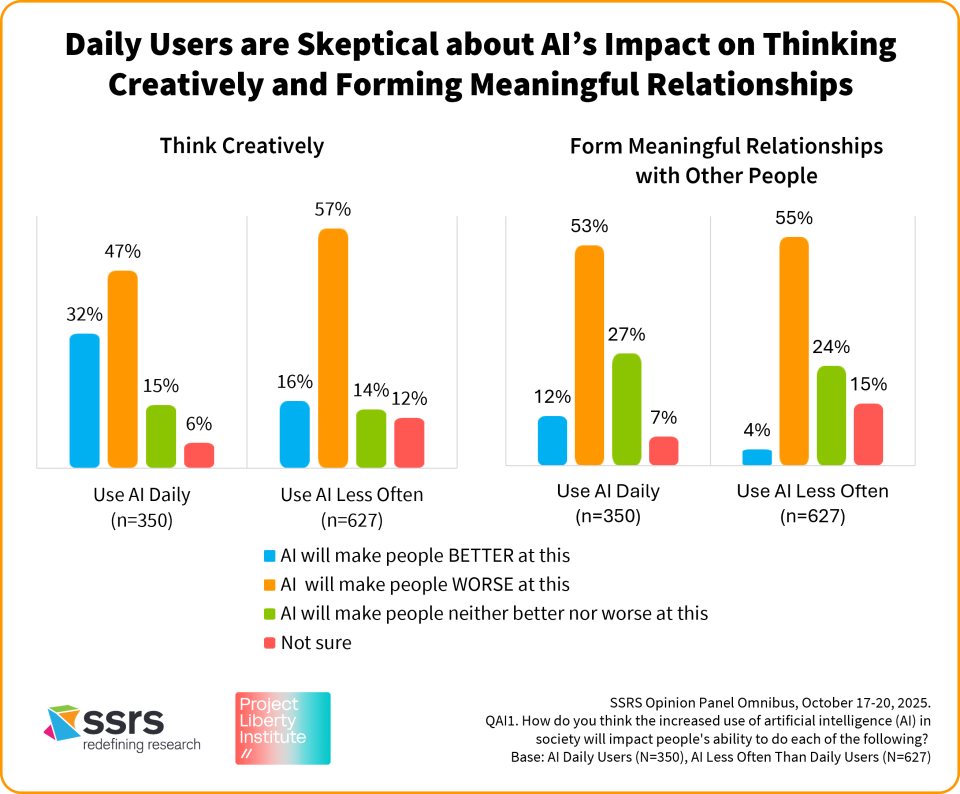
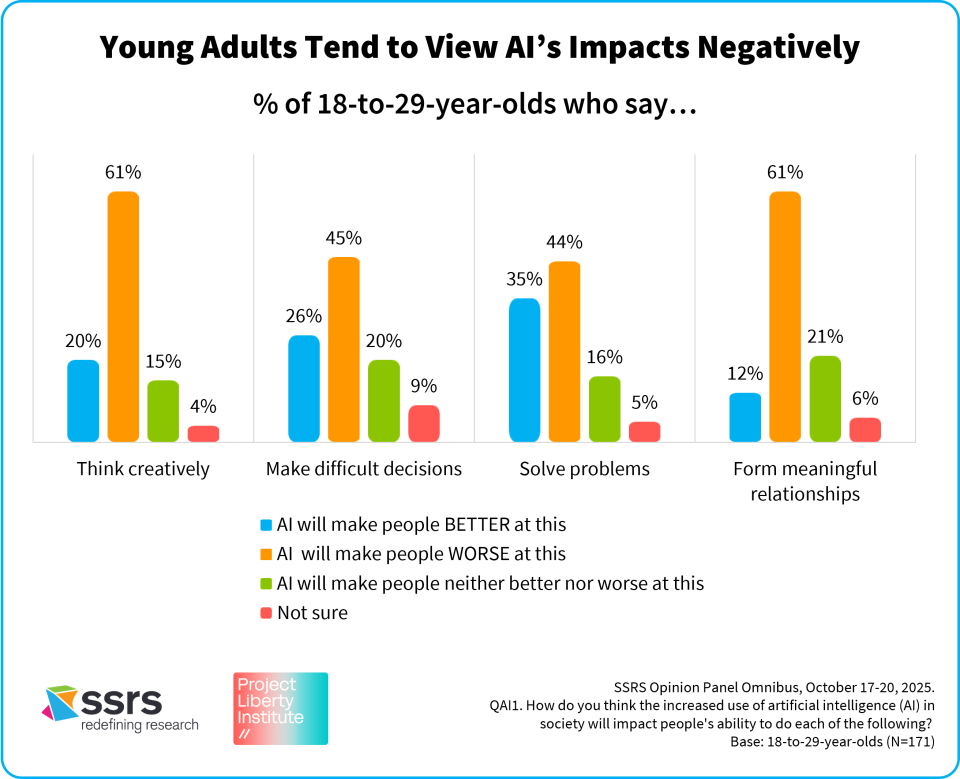
New survey data from SSRS and Project Liberty Institute (PLI) show that majorities continue to view negatively AI’s impact on our ability to think creatively and form meaningful human relationships.

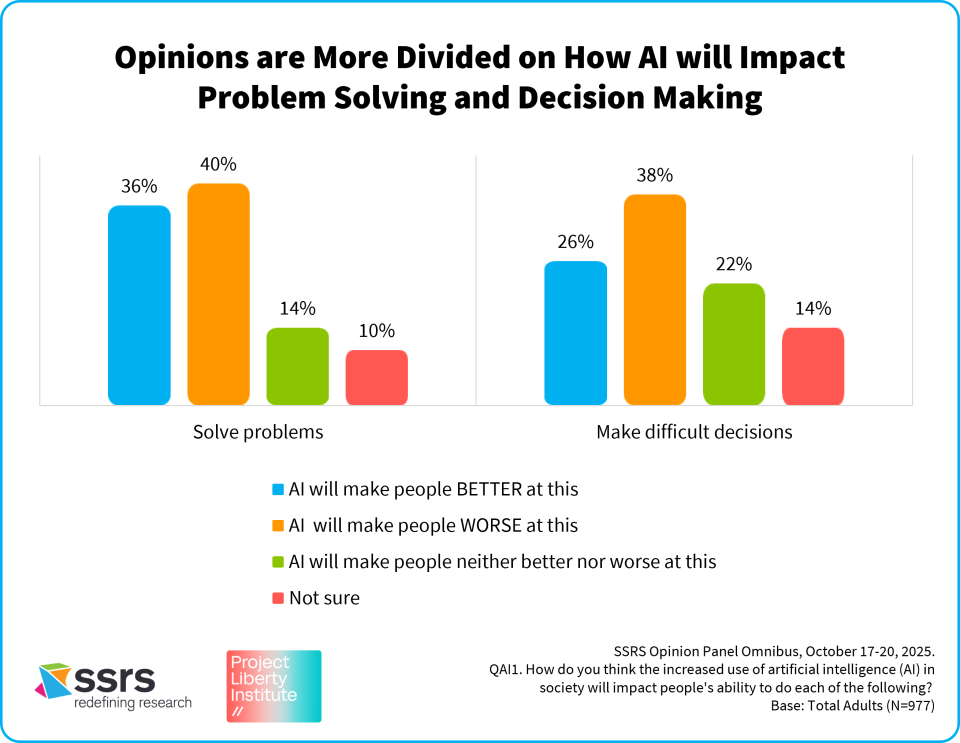
Opinions on AI’s impact on two more “instrumental” traits—our ability to solve problems and make difficult decisions—are slightly more balanced, though still lean negative.
These findings echo other research showing generally negative public perceptions of the impacts of AI use on many of the core cognitive skills and traits that make us uniquely human (see prior work from Project Liberty Institute, Elon University’s Imagining the Digital Future Center, and Pew Research Center).
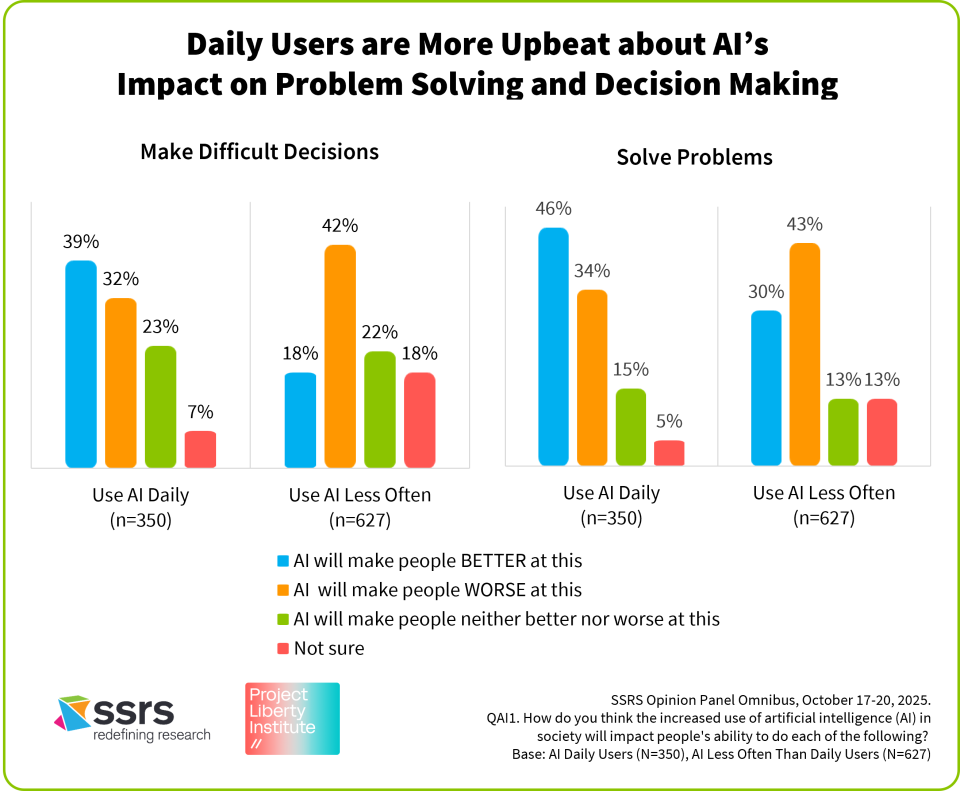
To some degree, heavier AI users—particularly the four percent of U.S. adults who say they use these tools “almost constantly”—are more upbeat about the technology’s capacity to enhance human abilities. But even here, fewer than half of all daily users say AI will make people better at solving problems (46%) or making decisions (39%).
When asked about AI’s effect on our ability to form meaningful human relationships, the 37% of U.S. adults who are daily AI users are even more skeptical. Among this group, more than four times as many say AI will make people worse at this as opposed to better (53% v. 12%).
Another surprising and potentially alarming trend for product developers trying to build the AI killer app, is that younger adults—presumably the target audience for most new AI-enabled tools—tend to view the impact of AI negatively, particularly when it comes to thinking creatively and forming meaningful human relationships.
Are these negative public sentiments just reactionary? Fear-based? Driven by gloomy predictions of jobs lost to AI or lack of understanding of how AI works?
Actually, it’s none of the above. In-depth interviews conducted with a subset of 18-to-29-year-olds who responded to the survey reveal a generation that is thoughtfully weighing the pros and cons of AI across different settings, deliberating about which trade-offs they are comfortable making in their own lives.
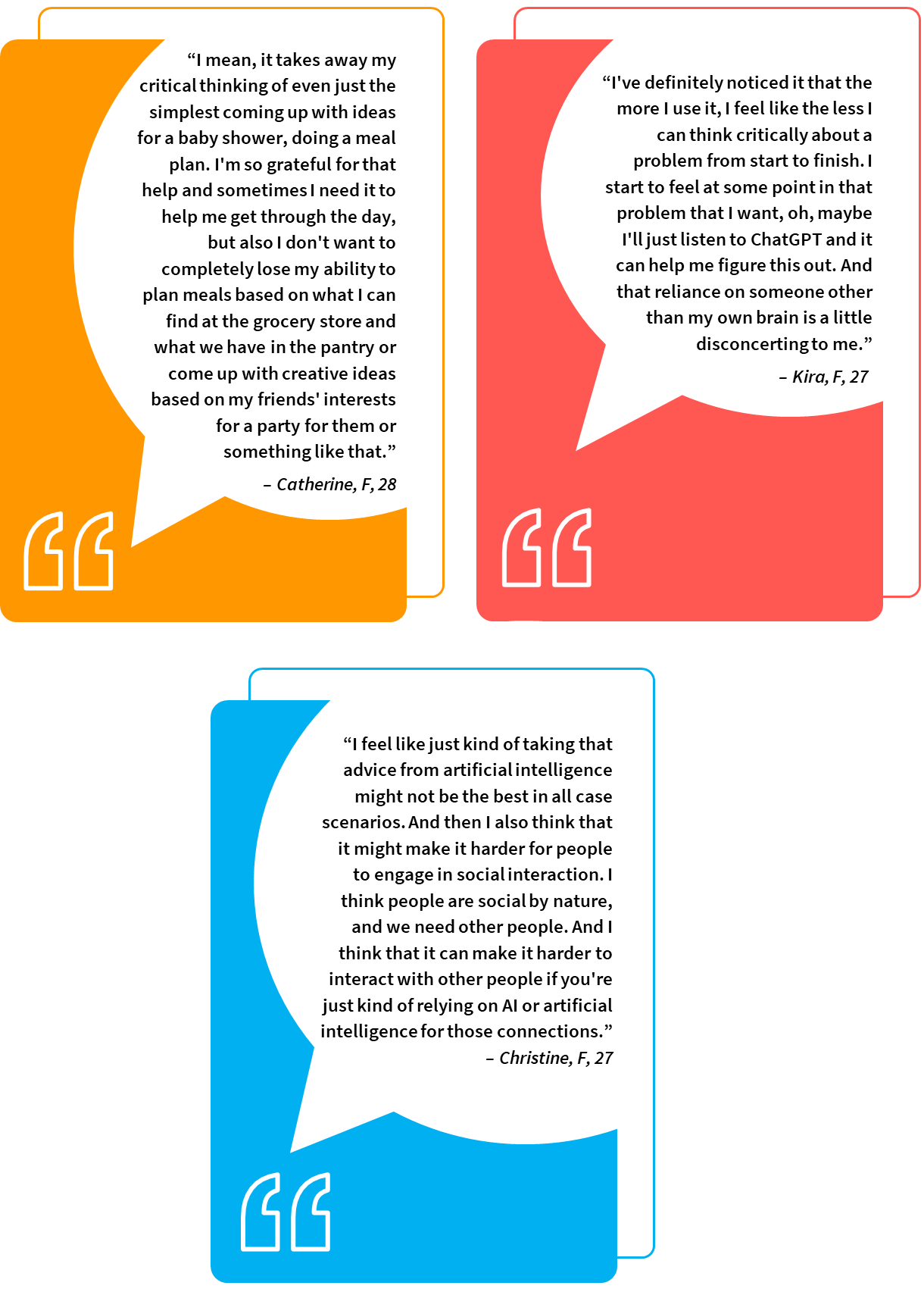
Most young adults we interviewed see some benefits to AI-enabled tools and platforms, particularly when it comes to instrumental, fact-based tasks. But they also see the more nuanced potential harms of embracing AI in what are traditionally human-to-human interactions. In their words (names have been changed to protect respondent privacy):
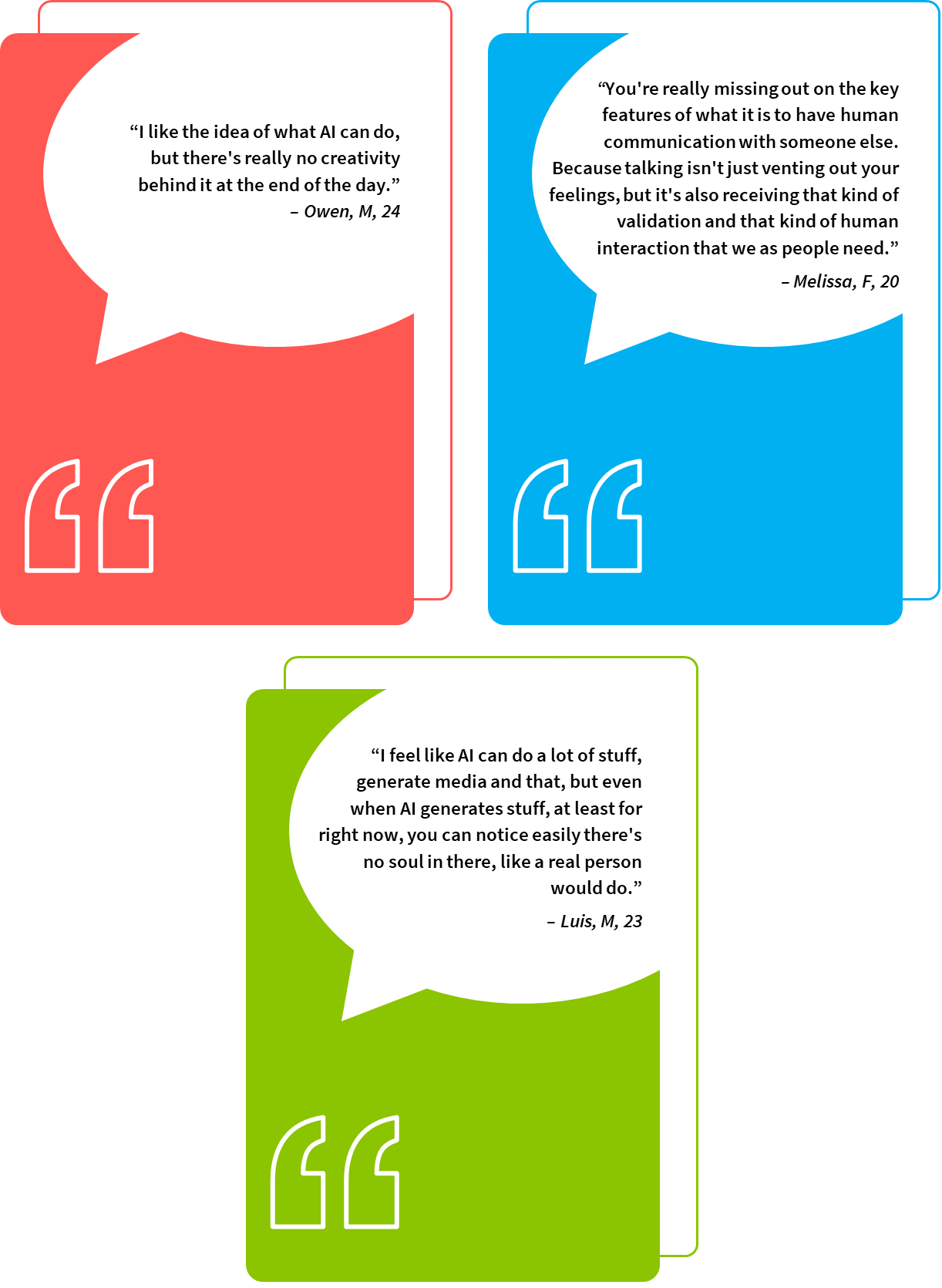
The interviews also revealed the interesting ways AI-enabled apps and tools have prompted many to think more deeply about the unique value that human beings – including themselves – bring to different interactions and settings. For some, AI has made the “human element” in experiences such as applying to jobs, seeking counseling or advice, or creating art even more apparent. This, in turn, has led them to reflect on whether that human dimension is something they are willing to give up.
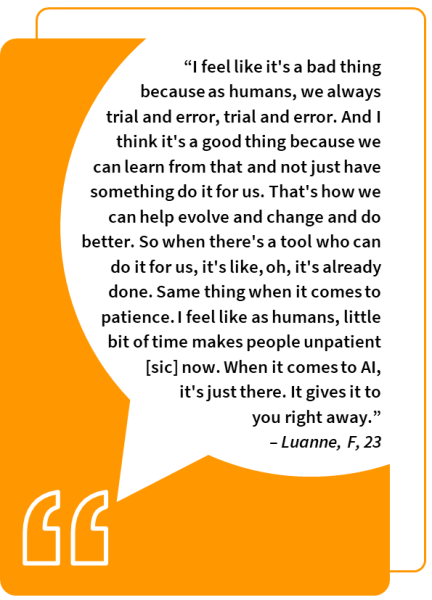
Notably, several young adults raised concerns about more extended impacts of the increasing use of AI, beyond specific contexts and interactions. They mentioned broader changes such as general impatience with tasks and with other human beings, unwillingness to learn through trial and error, and valuing ends over means.
What do these nuanced reflections mean for AI product developers and regulators? Ironically, human beings are approaching AI adoption in a very human—and ultimately rational—way. They are testing, evaluating, and weighing its usefulness before fully integrating it into their lives. AI is leading many to consciously reflect on the uniquely human elements of everyday interactions, perhaps for the first time. In doing so, it highlights the rare and often hard to measure value that humans contribute to the world.
The latter is something many wish to protect, even while they embrace the many ways AI can improve their lives. In the words of 27-year-old Greg, “What makes me excited about AI is that it’s not done yet, it’s a work in progress.”
Authors & Affiliations
- Kristen Purcell, SSRS
- Jeb Bell, Project Liberty Institute
- Jessica Theodule, Project Liberty Institute
Special thanks to Darby Steiger, Rachel Askew, Melissa Silesky, Hannah Ritz and the SSRS qualitative team for their work on this project.