
Grocery shopping is something most of us do without a second thought, but it has become a more intentional, and sometimes challenging, part of everyday life. As grocery prices remain high, shoppers are turning to warehouse clubs to stretch their dollars further. What was once a niche option for large families or small businesses has quickly become a go-to strategy for anyone looking to save.
New research from SSRS finds that:
- 62% of U.S. adults report that they or others in their household typically do grocery shopping at Walmart. About half (52%) say they typically shop at major grocery chains and 44% say their household typically grocery shops at warehouse clubs, such as Costco (28%), Sam’s Club (20%), or BJ’s Wholesale Club (6%).
- Warehouse club grocery shoppers are broadly satisfied with their clubs, but satisfaction is higher for quality, customer service, and trustworthiness than for membership fees and product prices.
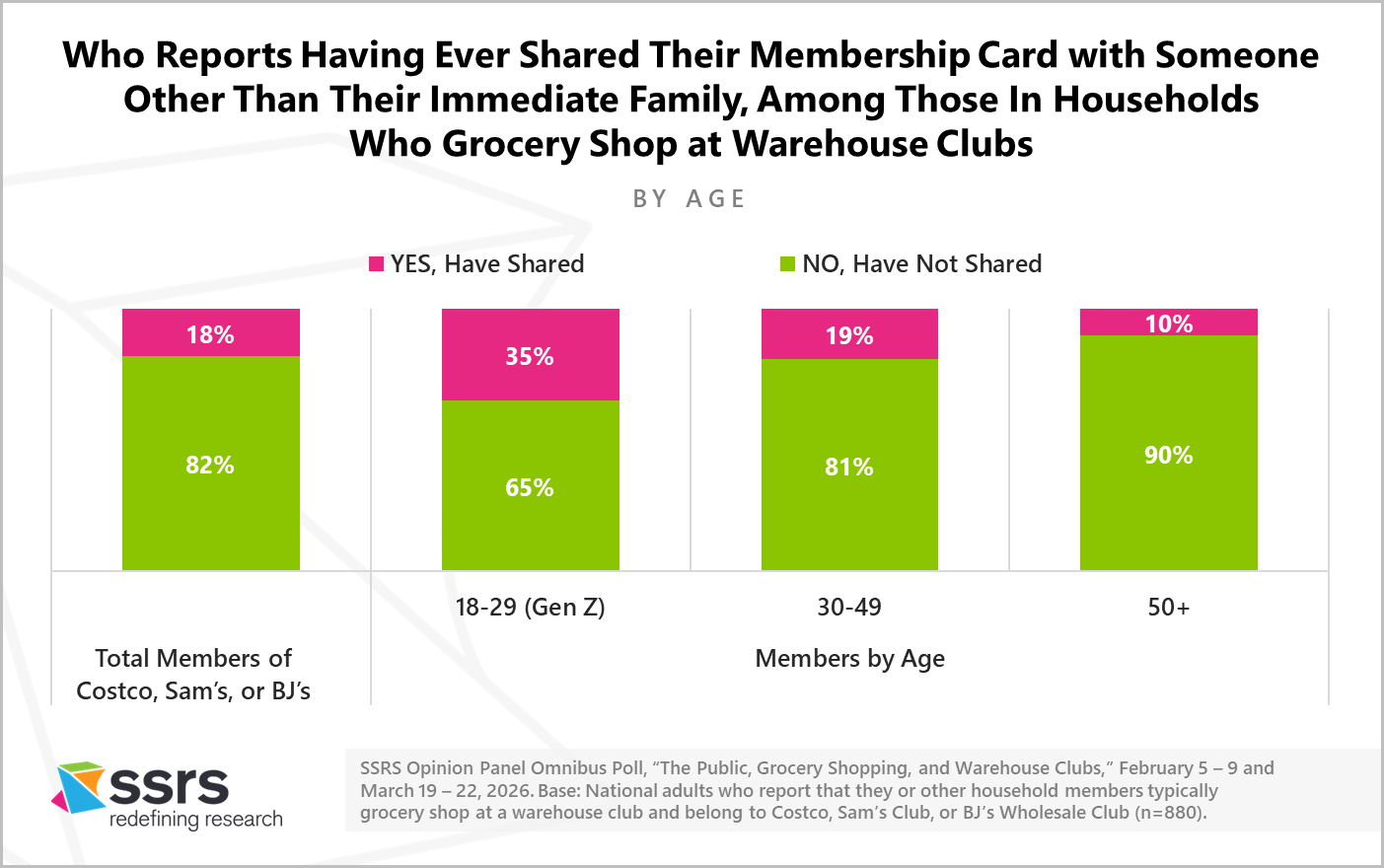
- Among those in households with warehouse club grocery shoppers, 18% report that they have ever shared their membership with someone outside their immediate family. This includes more than one-third (35%) of Gen Z adults (aged 18-29) who report that they have shared their membership.
These findings are part of an SSRS Opinion Panel Omnibus poll conducted February 5 – 9 and March 19 – 22, 2026, among a nationally representative sample of 2,008 adults aged 18 and older.
Where do people typically shop for groceries?
The SSRS Opinion Panel Omnibus poll finds that 62% of U.S. adults report that they or others in their household typically do grocery shopping at Walmart. About half (52%) say they typically shop at major grocery chains, such as Albertson’s, Kroger, Safeway, Wegmans, or Publix.
In addition, 44% say they or other household members typically grocery shop at warehouse clubs, such as Costco, Sam’s Club, or BJ’s Wholesale Club.
One-fourth or more say they or other household members typically grocery shop at Aldi (30%), local or independent grocery stores (29%), or dollar stores, such as Dollar General, or Dollar Tree (25%). About one in five U.S. adults report that they or household members typically grocery shop at online retailers (such as Amazon.com) (21%), Target (20%), or Trader Joe’s (18%).
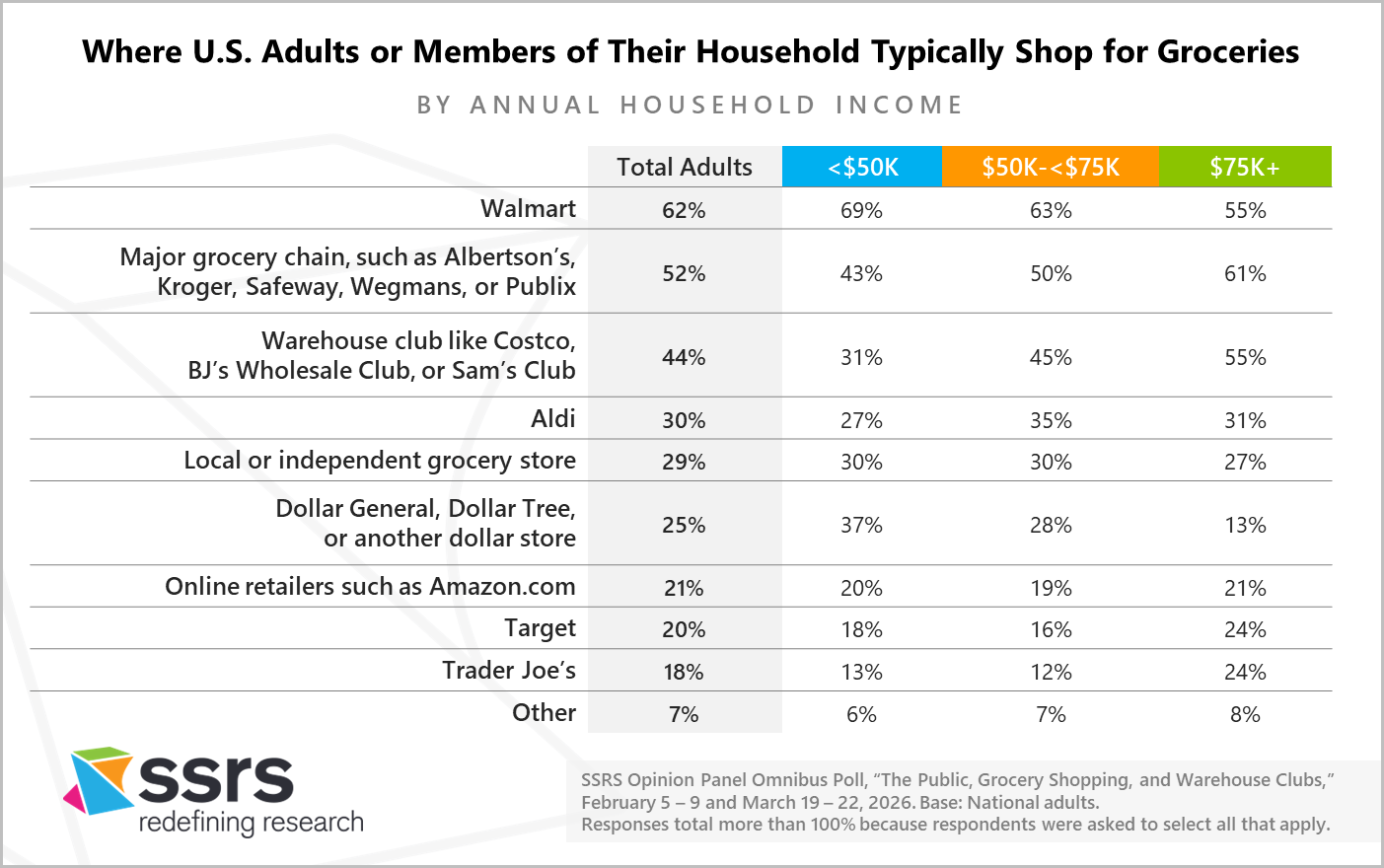
U.S. adults with household incomes of $75,000 or more per year are more likely than those with household incomes of less than $50,000 per year to report that they or other household members typically shop at major grocery chains (61% to 43%), warehouse clubs (55% to 31%), and Trader Joe’s (24% to 13%). They are also more likely than those with household incomes of $50,000 to less than $75,000 per year to report typically grocery shopping at each of those three locations.
U.S. adults with household incomes of less than $50,000 per year are more likely than those with household incomes of $75,000 or more per year to report typically grocery shopping at Walmart (69% to 55%) and dollar stores (37% to 13%).
Gen Z adults (age 18-29) are less likely than older age groups (51% to 63%) to report that they or other household members shop at major grocery chains, but they do not differ from older age groups in the proportion citing Walmart and warehouse clubs.
Grocery Shopping at Warehouse Clubs
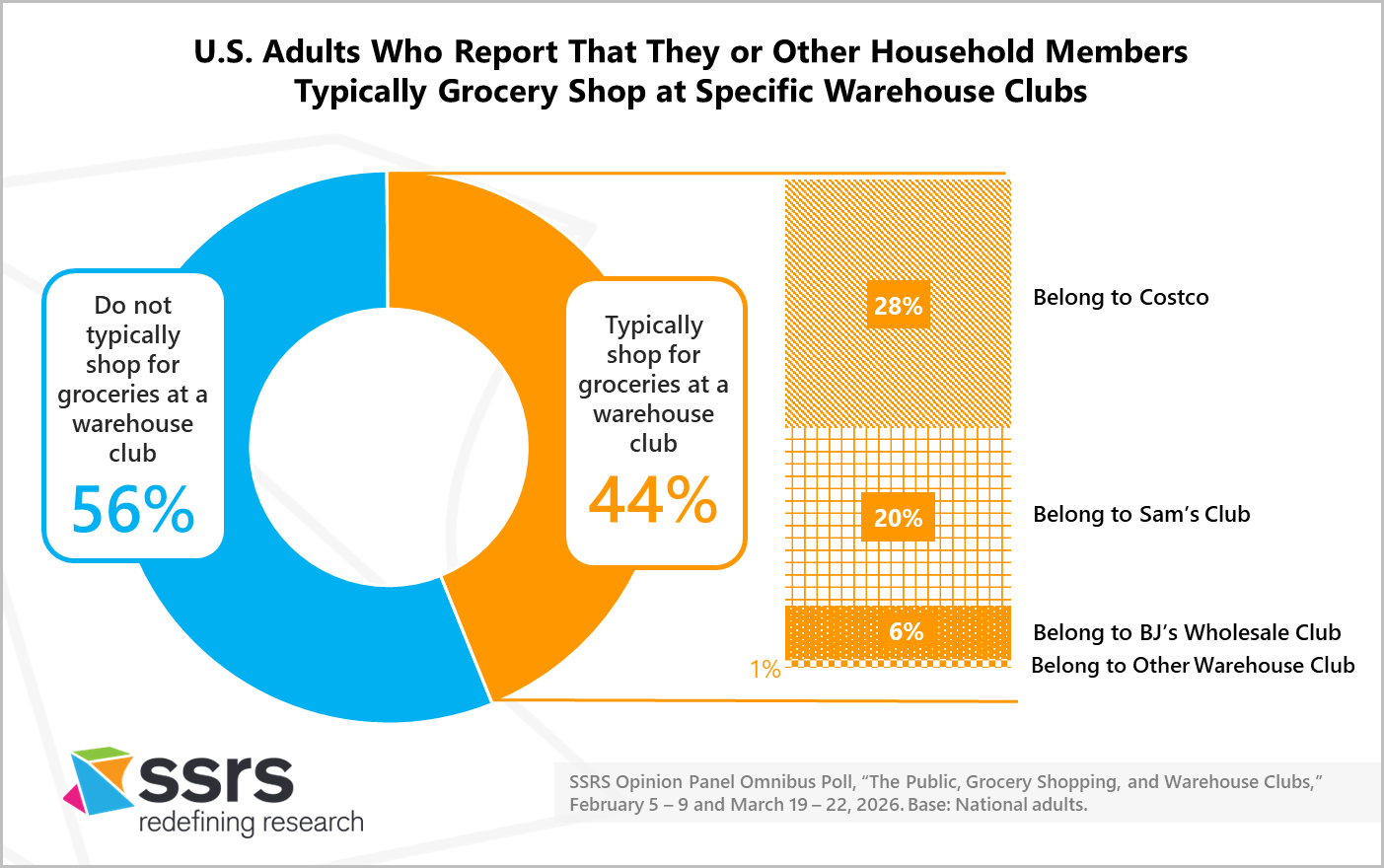
In the new SSRS Opinion Panel Omnibus poll, 44% of U.S. adults report that they or other household members typically shop for groceries at warehouse clubs.
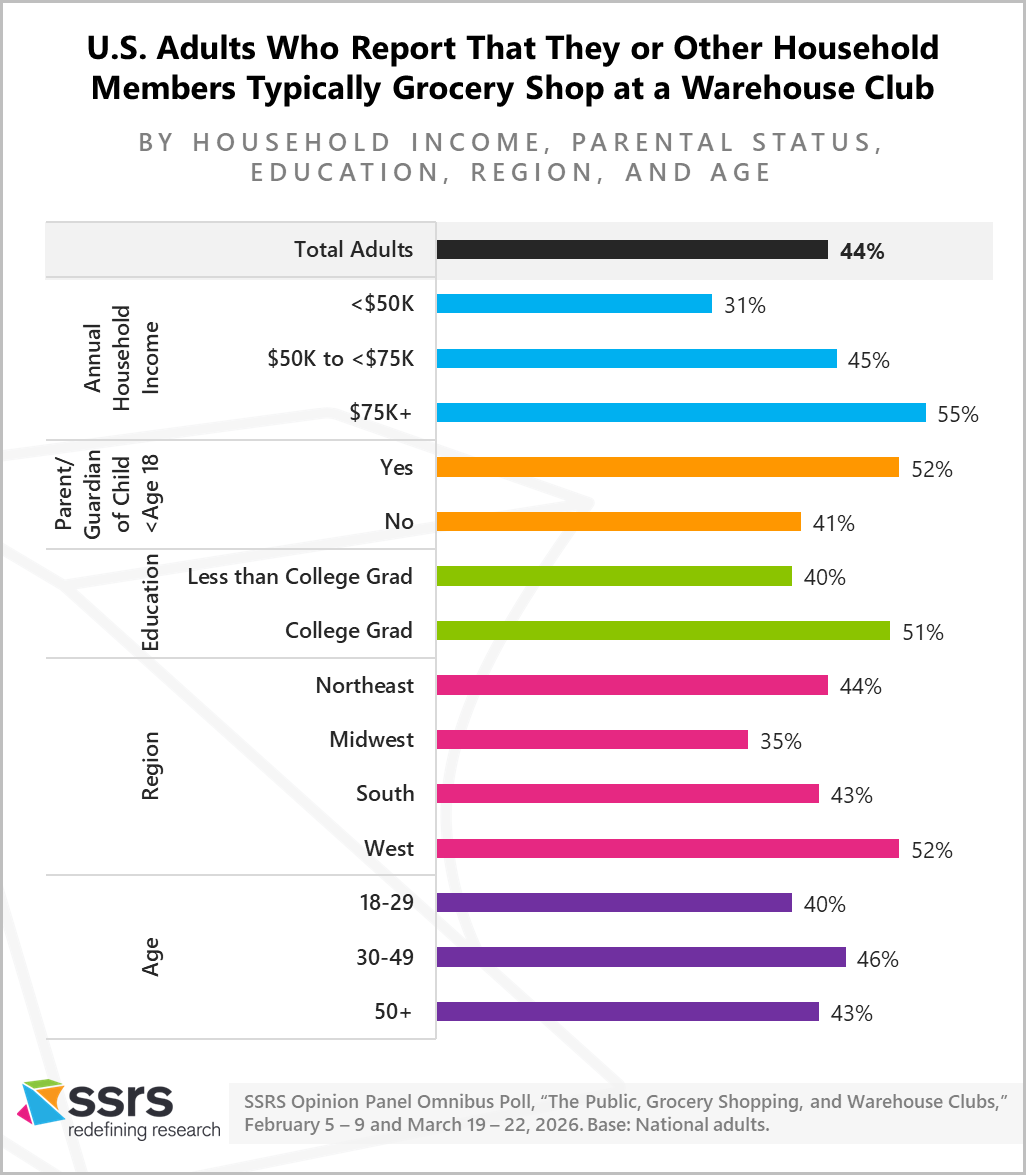
U.S. adults with household incomes of $75,000 or more per year are more likely than those with household incomes of less than $50,000 per year to report that they or other household members typically shop at a warehouse club (55% to 31%).
Parents or guardians of children under age 18 are more likely than other adults (52% to 41%) to report that they or other household members typically shop at a warehouse club; college graduates are more likely than non-graduates (51% to 40%), and those who live in the West (52%) are more likely than those in any other region to report that they or other household members typically shop at a warehouse club.
Grocery shopping at a warehouse club does not vary significantly by a respondent’s age.
When it comes to grocery shopping at a warehouse club, more specifically 28% of U.S. adults say they belong to Costco, 20% to Sam’s Club, and 6% to BJ’s Wholesale Club. (Some adults belong to more than one warehouse club.)
Adults in households that grocery shop at warehouse clubs are generally satisfied with the clubs to which they belong. The percentage reporting that they are “very or somewhat satisfied” with the membership fee ranges from 80% to 88%, depending on the specific club to which they belong; with the price of products, 90% to 94%; with the quality of products, 91% to 97%; customer service, 88% to 96%; and trustworthiness, 93% to 99%.
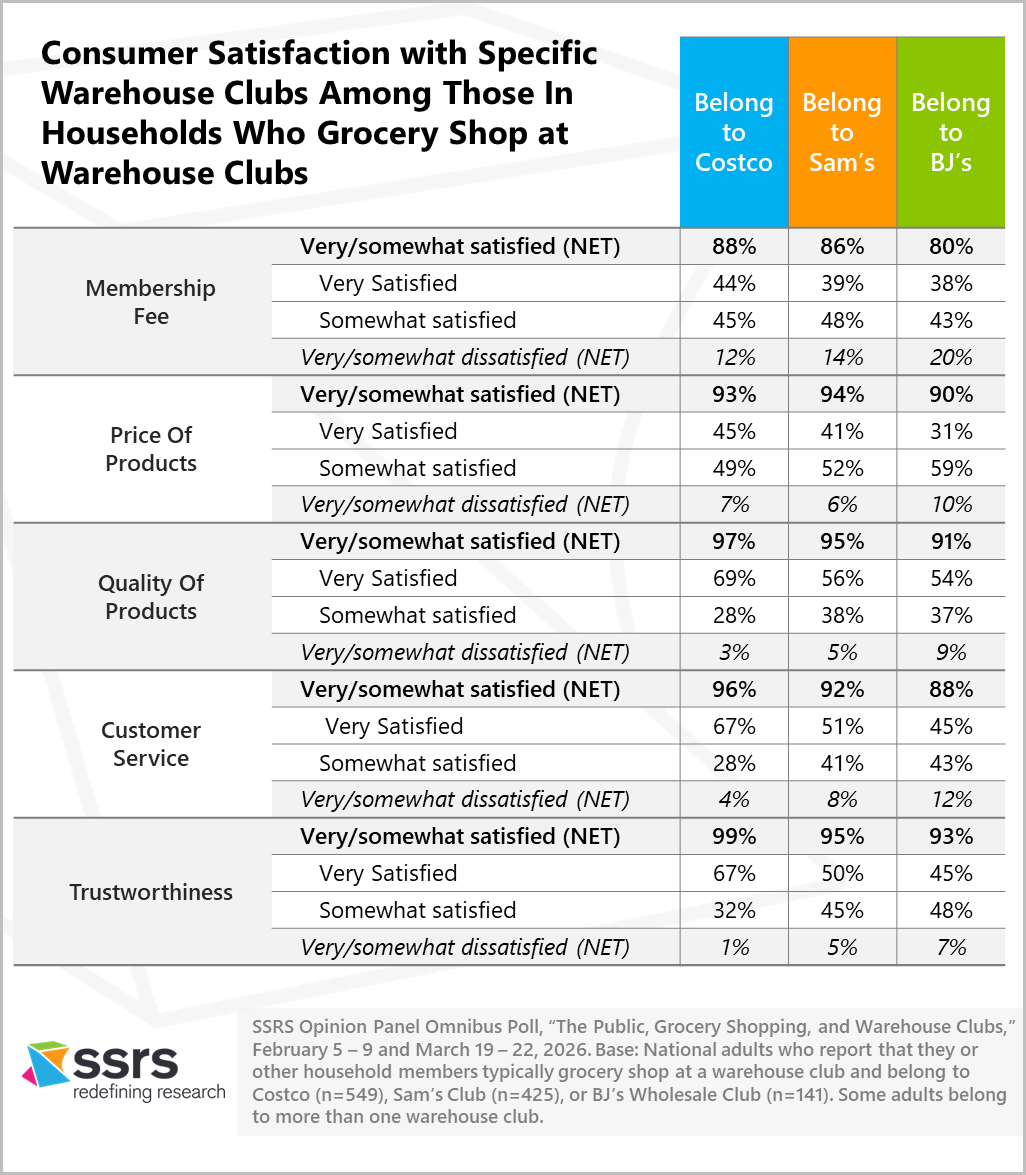
It should not be surprising that people are generally satisfied with the clubs to which they choose to belong. As a result, looking at the proportion reporting that they are “very satisfied” might be a more useful measure.
The poll finds that warehouse club members are generally more likely to say they are “very satisfied” with quality (54% to 69%), customer service (45% to 67%), and trustworthiness (45% to 67%) than with membership fees (38% to 44%) and the price of products (31% to 45%).
Two-thirds or more Costco members report that they are “very satisfied” with quality (69%), customer service (67%), and trustworthiness (67%).
Sharing Warehouse Club Memberships with People Who Are Not Immediate Family
The poll finds that 18% of those in households who grocery shop at warehouse clubs report that they have ever shared their membership with someone outside their immediate family. This includes more than one-third (35%) of Gen Z adults (aged 18-29) who report that they have shared their membership.
Warehouse clubs generally have restrictions on who can use a person’s membership card.
Methodology
Interviews for this study were conducted on the SSRS Opinion Panel Omnibus from February 5 – 9 and March 19 – 22, 2026, among a nationally representative sample of 2,008 respondents aged 18 and older. The margin of error for total respondents is +/-2.5 percentage points at the 95% confidence level. The design effect is 1.26. View the topline >>
The SSRS Opinion Panel Omnibus is a multi-client, probability-based survey that fields twice a month. It delivers a nationally representative sample of 1,000 adults aged 18 or older in English (with Spanish language option). Data collection is conducted online and via phone (for non-internet and web-reluctant respondents) using the probability-based SSRS Opinion Panel.