Our presentation at the Quirk’s Event in New York City last summer included insights from our Sports Poll, the first sports fan intelligence product in the US. We explained how five fan dynamics can help drive lifetime engagement. Many of you wanted to know how our approach can be applied to your audience.
In our series, “Using Sports Poll Fan Dynamics to Drive Lifetime Engagement,” we explore each dynamic in more detail and provide research that shows them in action.
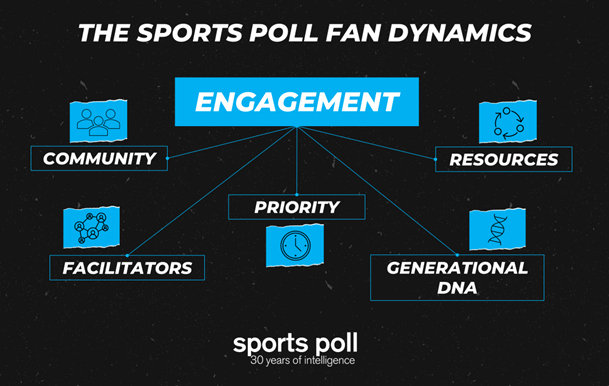
The five dynamics include: Priority, Community, Facilitators, Resources, and Generational DNA. Each dynamic is linked to higher fan engagement. The framework can apply to any type of free time activity, not just sports.
We covered Priority, Community, and Facilitators in our first three releases. The fourth release of the series focuses on “Resources.” Read on to learn more about how resources link to engagement for fans.
The “perfect” fan doesn’t exist because of limited resources
If we wanted to build the perfect fan, they would have an endless amount of free time, plenty of discretionary money, and easy access to their favorite activities. These three “resources” have held as the most predictive of fan engagement for the 30 years Sports Poll has been studying sports fans. The more access, time, and money a fan has, the more they engage. The more they watch, attend, and spend. The importance of these resources holds for nearly every other free time activity we track as well.
The free time-poor must prioritize how they spend their time
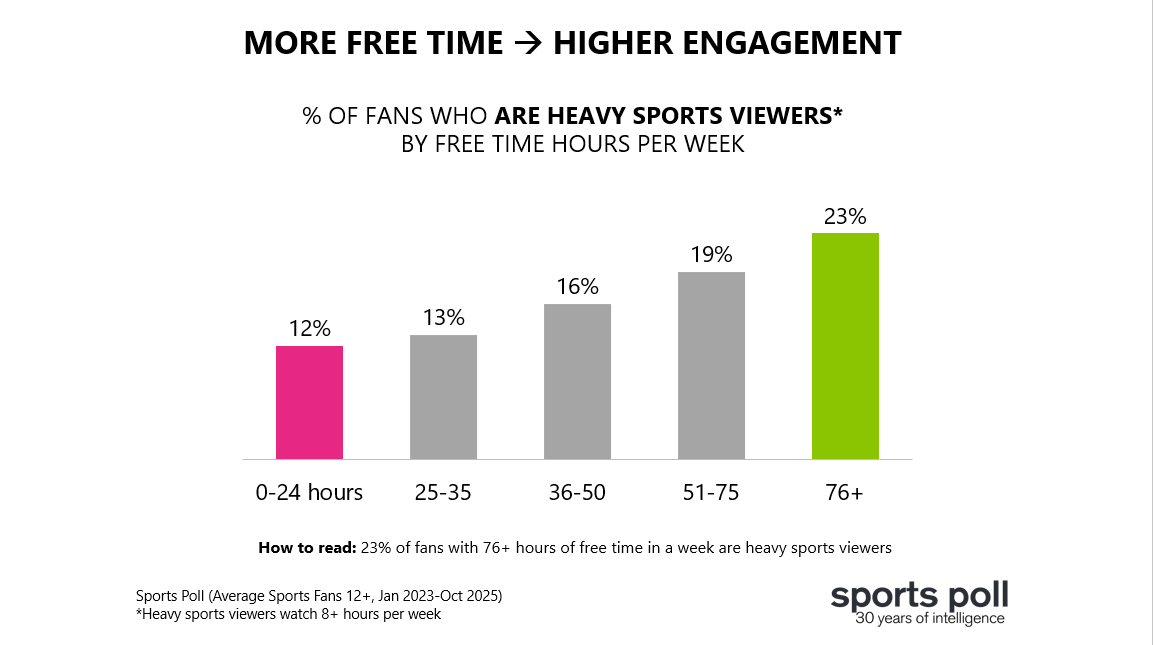
Sports Poll has measured free time in a variety of ways since 1994. One way is to ask Americans how many hours of free time they have in a typical week. Then we break this into five categories based on the hours they have. Each category includes roughly 20% of the population. Those who have “a lot less” say they have 24 or fewer hours in a typical week. On the other extreme, those with “a lot more” have at least 76 hours in a week. As fans have more free time, they watch more sports on TV or streaming. Note that we control for sports fandom in each of these charts by isolating “Average sports fans” (4-7 on our 0-10 scale).
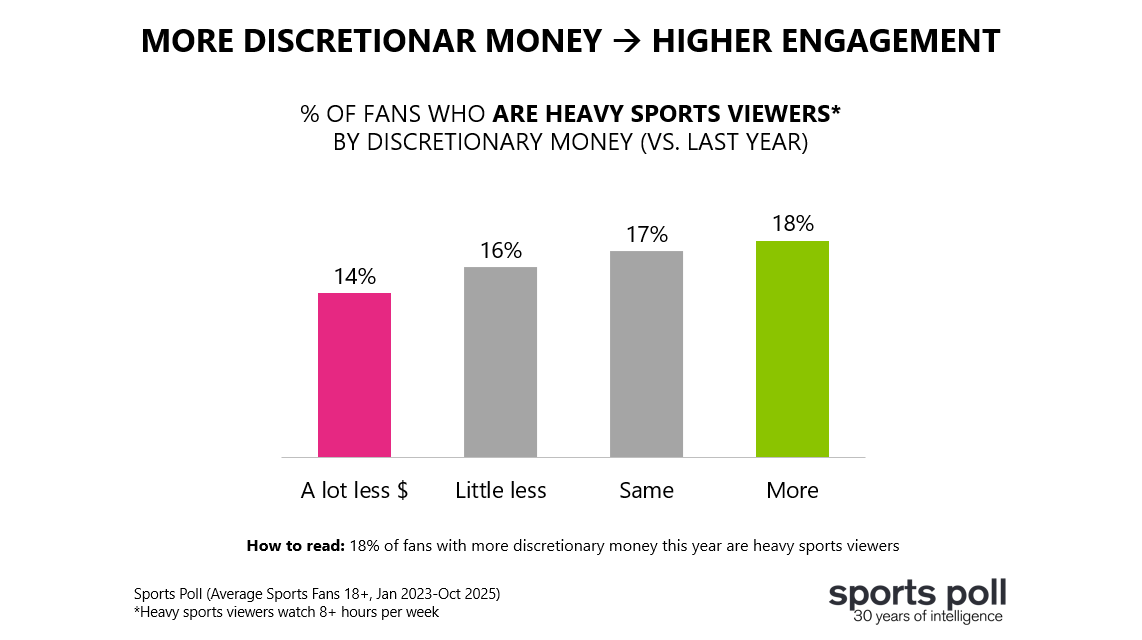
Fans engage more when they have more discretionary money
Between 2008 and 2010, we noticed substantial declines in sports fandom and engagement during the financial crisis. As we worked to understand the impact of the crisis on Americans, one of the most powerful indicators was our measure of discretionary money. People with more discretionary money have more to spend compared to last year. People with less have less money to spend. Those with more discretionary money are bigger fans, attend more events, support sponsors more, and watch more sports. The impact varies depending on the activity – changes typically have a greater impact on costly activities (like attending) – but the relationship holds for nearly every sport and activity we track.
Access is becoming the biggest constraint to fan engagement
Time and money are straightforward, but “access” can take on different meanings. Access for live events includes proximity to the actual venues and events. As a live music fan in Raleigh, I have access to more than a dozen music venues within an hour from home. A few are within walking distance. Live music is far more accessible to me than a fan living in rural North Carolina. Naturally, live event attendance is closely tied to proximity for sports and other free time activities.
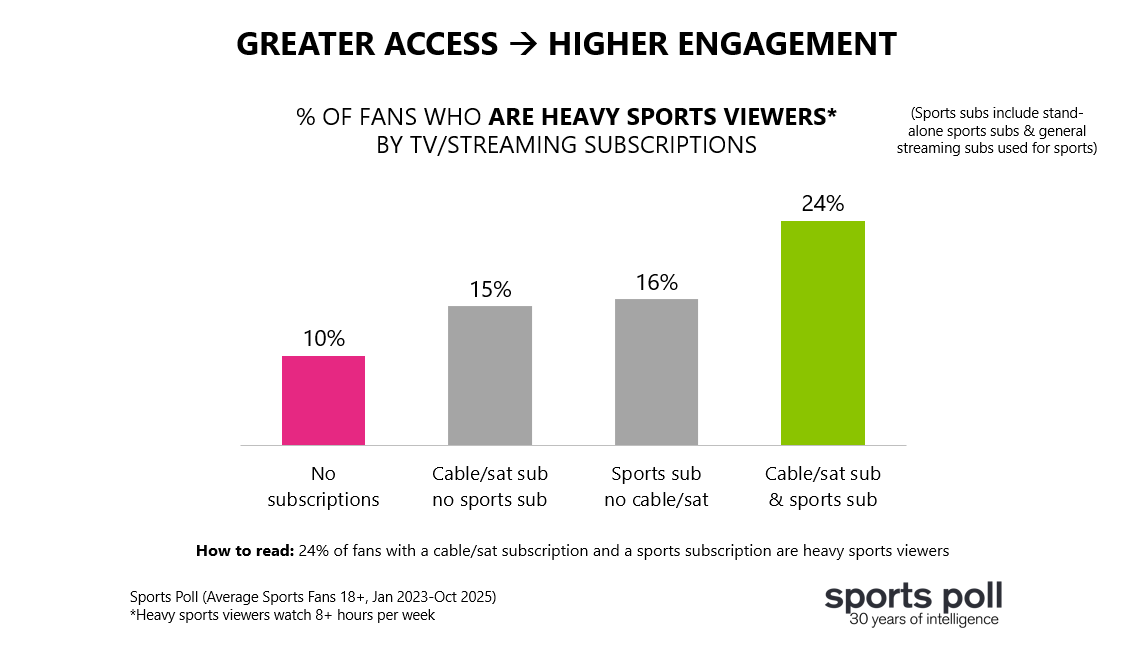
For media, access means the ability to regularly watch events on TV or streaming. This has become a growing concern in sports in the past decade as fewer Americans have traditional multichannel (cable/satellite) subscriptions and more events are only available on streaming. One way we measure media access is to break fans into categories based on their multichannel and streaming services. The lowest bar is fans who don’t have a multichannel or sports subscription. The highest bar is fans with both a multichannel subscription and at least one sports subscription. The more subscriptions a fan has, the more they engage. That’s logical. The problem is this means fewer fans have access to what they want to watch, so they won’t watch as much.
How can we increase engagement when fans have limited resources?
In a perfect world, every fan would have unlimited access, time, and money. Note the higher sports viewing for this group in the chart below. We know that’s not realistic. Nearly every person has at least one constraint that limits what they can do in their free time. The more constraints someone has, the less they engage.
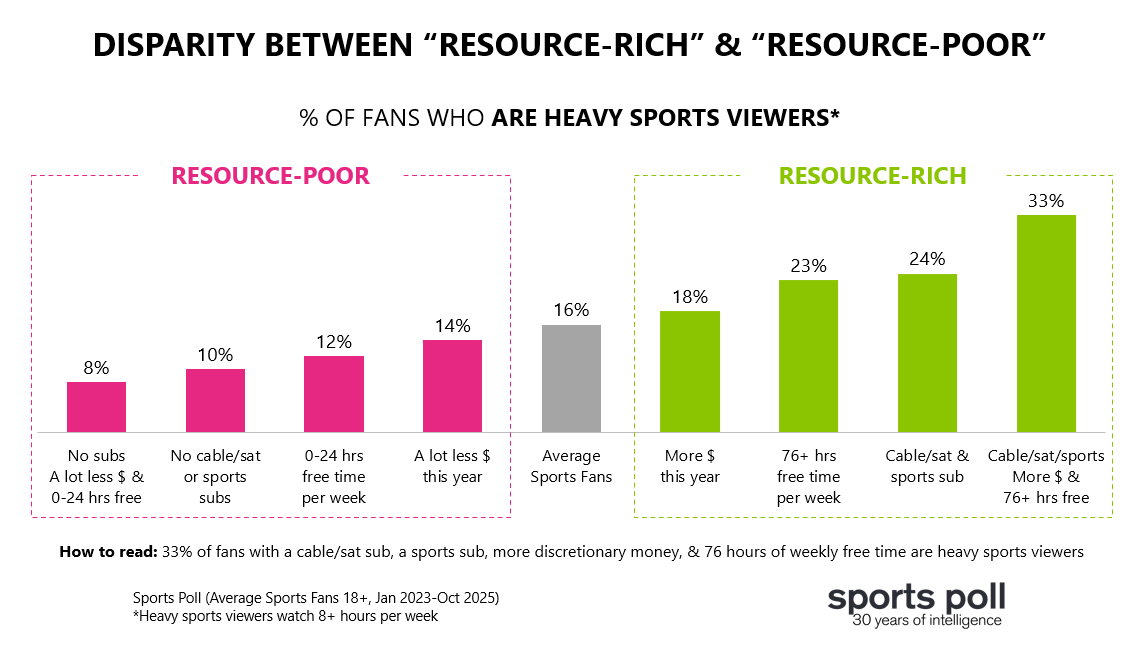
People will prioritize and make do with activities within their limits. Here’s how you can maximize engagement when resources are limited:
1. Understand which resources are most important to your fan activities. Discretionary money and free time can have a larger impact on more expensive activities like attending events or travel. They have less of an impact on (relatively) inexpensive activities like streaming or playing video games.
2. Identify your “resource-rich” and “resource-poor”. Females tend to have less free time than males. Younger Americans (especially ages 18-34) have more limited access to sports media. Older Americans have the most free time but are more cost-conscious.
3. Develop new programs to engage the resource-poor. Fans who have limited time are looking for activities that require less effort. Promotions can bring in fans with limited discretionary money. Expanding media partnerships (or adding free TV partners) can engage fans with limited access.
4. Reward the resource-rich and maximize their value. These are the fans who engage the most on their own, but they are also the ones who can facilitate activities for other fans.