
The most recent Garden State Panel Omnibus examined the experiences of caregivers across New Jersey using a series of questions developed with partners ARCHANGELS. The study was conducted June 25-29, 2026 among a representative sample of n=1,006 NJ adults ages 18 and older. Caregiving was defined in the survey as “providing unpaid care or assistance to a friend or family member who needs assistance due to aging, disability or chronic illness.”
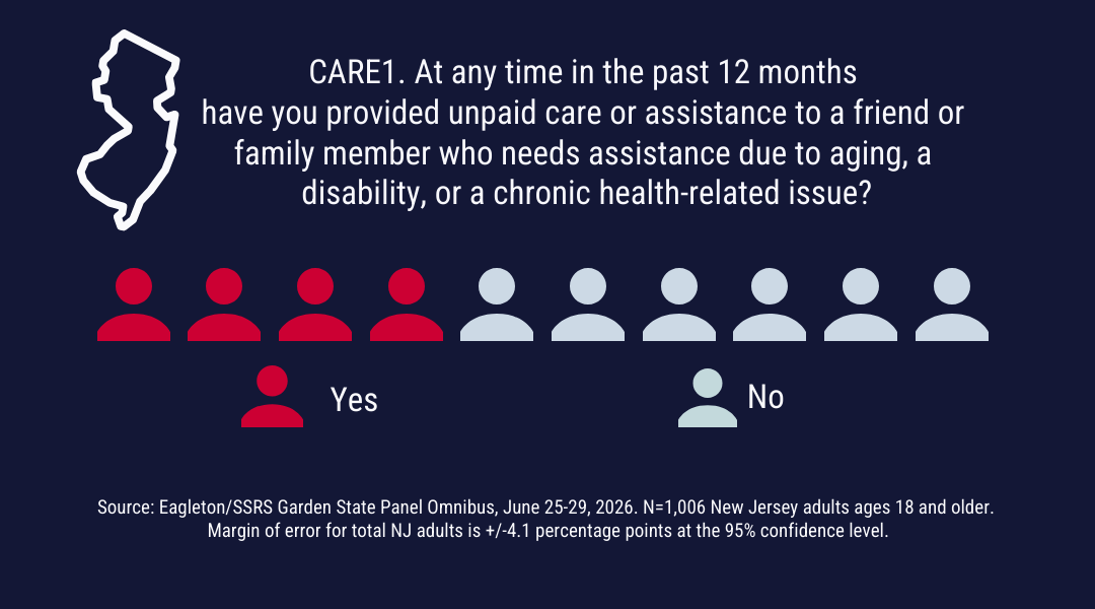
The Omnibus found that 39% of NJ adults (roughly 2.9 million residents) are providing essential, unpaid support to friends and loved ones, with caregiving cutting across all demographic groups in the state.
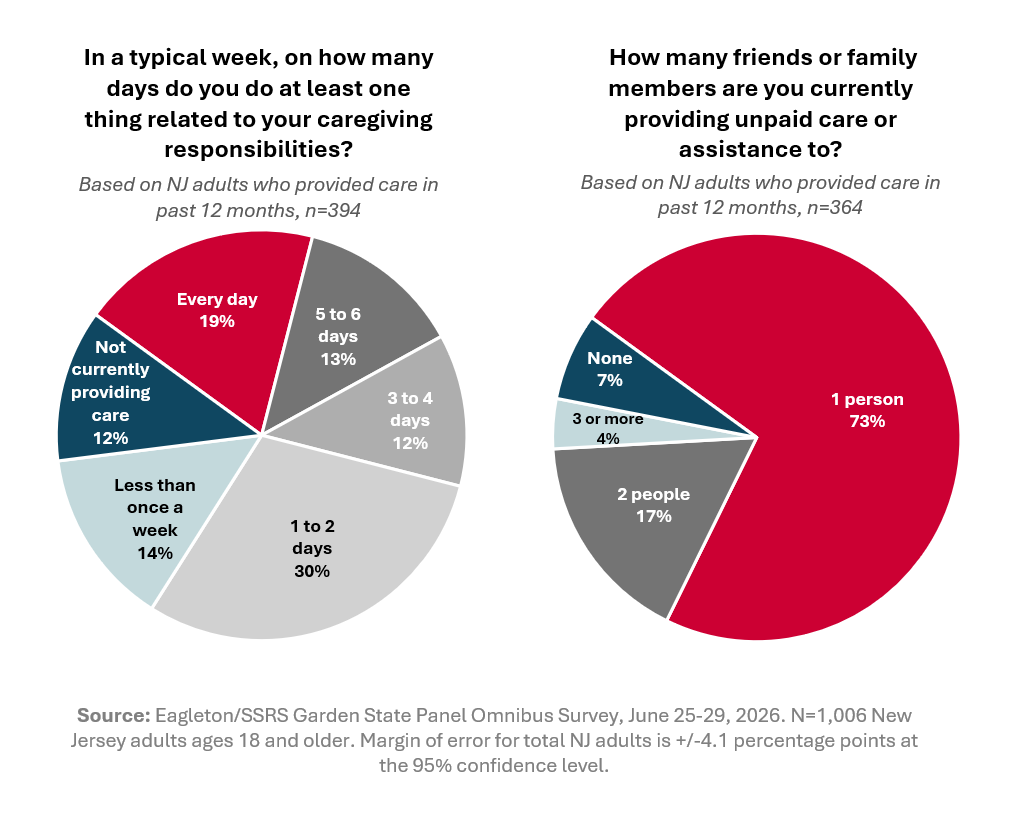
Many are doing it while holding a job, and some are caring for more than one person at once. For three in four, caregiving is part of every week. That includes nearly one in five caregivers for whom it is part of every day.
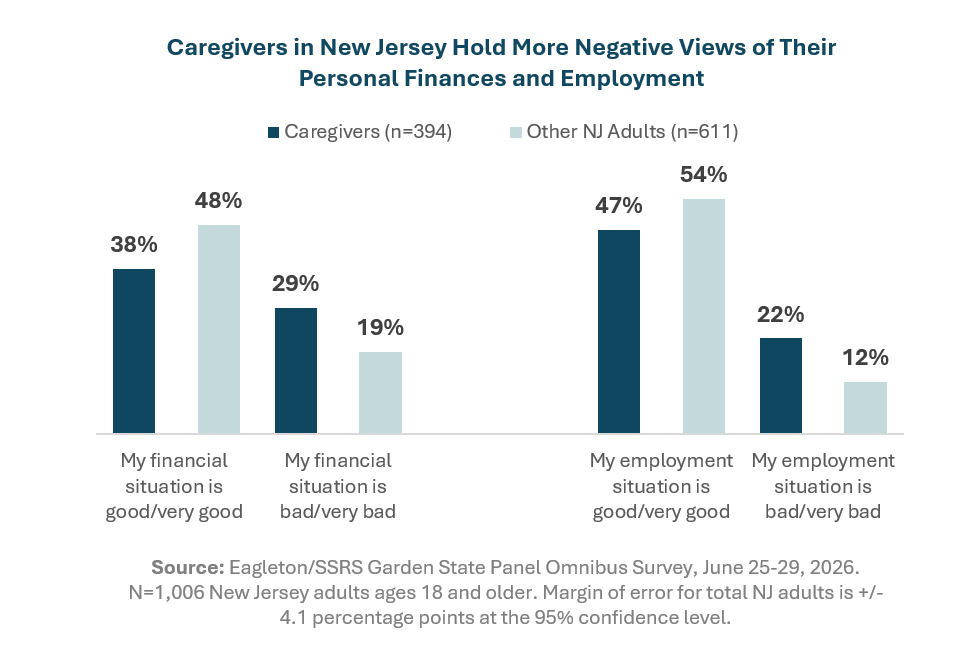
Caregivers are more likely than non-caregiving residents to rate their personal finances and employment as ‘bad’ or ‘very bad,” a gap that shows up in the trade-offs they report.
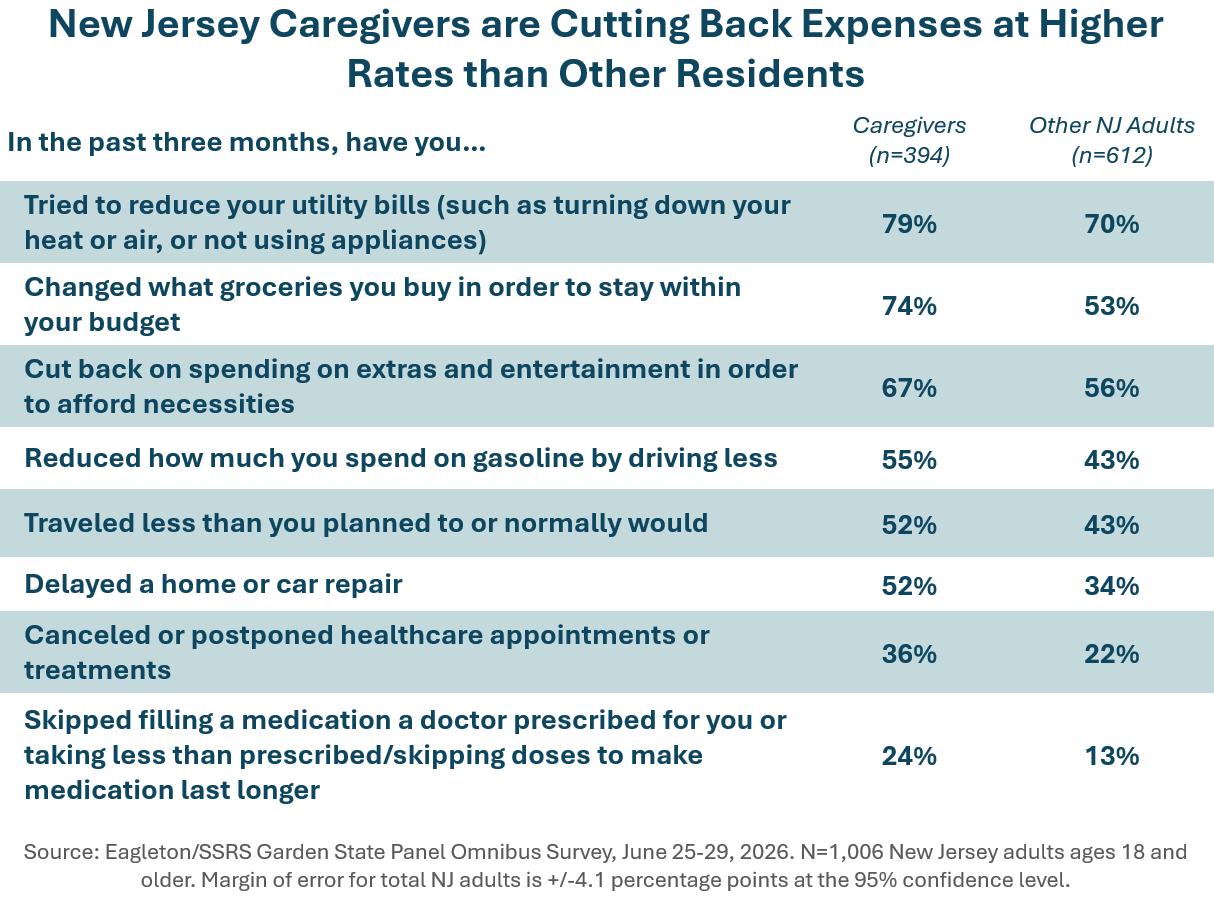
Caregivers report cutting back expenses at higher rates than other New Jerseyans. Two in three have cut back on extras and entertainment. Three in four have changed how they shop for food. Half are living with a car or home repair they cannot afford to make. One in three have canceled or delayed a medical appointment. One in four have skipped refilling a prescription or are taking less than prescribed so their medication lasts longer.
1. Four in ten New Jerseyans are caregivers.
In the past 12 months, 39% of New Jersey adults provided unpaid care to a friend or family member. That is six percentage points higher than the 33% national rate and equates to 2.9 million caregivers statewide. At that scale, caregiving is happening everywhere. Caregivers are in every neighborhood, in every workplace, and are being served by every health system and agency operating in the state, whether visible or not.
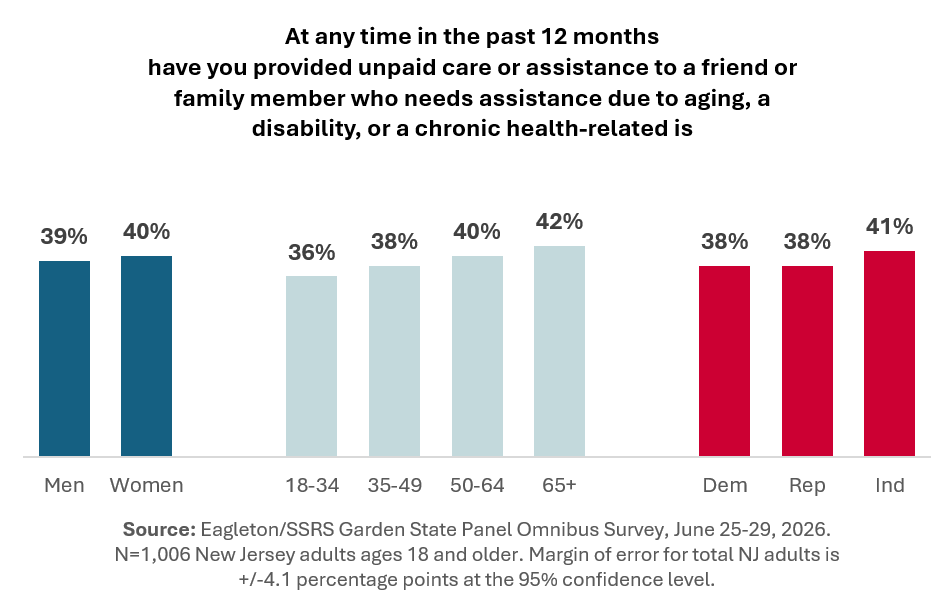
2. Caregiving cuts across every age, gender, and political party.
Caregiving is a widely shared experience. Men and women in the state are equally likely to report being a caregiver. So are residents who identify as Democrat, Republican or Independent. And caregiving is not unique to any particular age group, with 36% of NJ’s youngest adults (ages 18-34) serving as caregivers. For those serving caregivers, outreach needs to target and engage the full spectrum of the caregivers.
3. For one in five NJ caregivers, caregiving happens every day.
Overall, 74% of NJ’s caregivers are doing something caregiving-related at least one day a week, including 19% who do so daily. While the majority are caregivers for one person, 21% are currently providing unpaid care for two or more people. For the vast majority, caregiving contends with work schedules, appointments, and personal time every week.
4. Most are juggling caregiving with work and family.
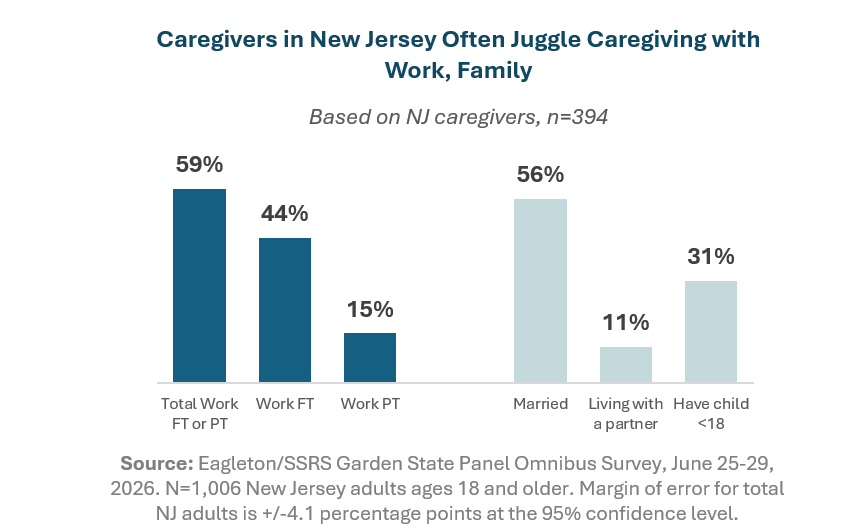
A majority of NJ caregivers (59%) are employed full-time or part-time. Two out of three are married or living with a partner (67%) and 31% are raising children under 18. Many undoubtedly fall into the “sandwich generation,” carrying some of the highest rates of caregiver intensity and mental health impacts. (ARCHANGELS and SSRS examined sandwich caregivers in an article in the American Journal of Health Promotion earlier this year.)
5. Caregivers feel more financial strain than other New Jerseyans and are cutting back expenses at higher rates.
As noted in a recent Garden State Panel Omnibus report, New Jerseyans view their own personal financial situations fairly positively, especially when compared with their views of the national economy and with how Americans overall rate their personal financial situations. Yet some segments of the NJ adult population, including young adults, Black and Hispanic residents, and those with household incomes below $50,000, are feeling significant financial strain.
Caregivers sit squarely in that group.
When compared with residents who have not been a caregiver in the past 12 months, NJ’s caregivers are more likely to rate their own finances and employment negatively. Three in ten caregivers in the state (29%) say their personal financial situation is “bad” or “very bad.”
NJ caregivers report cutting back at higher rates on every expense asked about.
The widest gaps are changing what groceries they buy (74% of caregivers have done this v. 53% of other NJ adults) and delaying home or car repairs (52% of caregivers have done this v. 34% of other NJ adults). Of particular concern: one in three NJ caregivers (36%) report canceling or postponing healthcare appointments or treatments in the past 3 months, and one in four (24%) skipped filling a medication or taking less than prescribed over that same time. Both rates are higher than what other residents report.
Caregiving in New Jersey is everywhere, even if it isn’t always visible.
These data are an opportunity for everyone in the state—including employers, health systems, and policymakers—to not only “see” this population of 2.9 million New Jerseyans, but to understand the breadth and impact of caregiving statewide. As ARCHANGELS research consistently shows, outreach and support are critical to caregiver wellbeing, and reaching a group this broad calls for creative approaches that meet caregivers where they already are and speak to the full range of what caregiving looks like.
About the Study
This study was conducted on the Rutgers-Eagleton/SSRS Garden State Panel Omnibus. The Garden State Panel Omnibus is a quarterly, statewide survey of NJ adults. Data collection was conducted from June 25 – June 29, 2026, among a sample of 1,006 respondents. The survey was conducted via web and administered in English (n=992) and Spanish (n=14). The margin of error for total respondents is +/-4.1 percentage points at the 95% confidence level. All Garden State Panel Omnibus data are weighted to represent the target population of New Jersey adults ages 18 or older. View the Topline >>
The Garden State Panel Omnibus is conducted on the Rutgers-Eagleton/SSRS Garden State Panel. The Panel is a joint research venture between The Eagleton Center for Public Interest Polling at the Eagleton Institute of Politics at Rutgers-New Brunswick (ECPIP) and SSRS. It is a probability-based panel of New Jersey adults age 18 or older. Members are recruited randomly based on statewide representative ABS (Address Based Sample) design. ABS sample is drawn from the Delivery Sequence File (DSF) maintained by the U.S. Postal Service. Population coverage of the DSF is in the 98%-99% range.
About the Study Partners
ARCHANGELS, a public benefit corporation, is a women-owned, omni-channel platform hustling to make change happen for unpaid caregivers across the nation. Through the validated Caregiver Intensity Index®, ARCHANGELS works with states, employers, brands, health systems, and local organizations to create impact for unpaid caregivers and their communities, drive ROI in a low-lift, high-impact way, and amplify policy and advocacy efforts with the data and stories generated through these initiatives. Learn more at archangels.me.
About Caregiver Intensity
Caregiver Intensity is a dynamic measure that helps caregivers get support so they can keep caring while staying healthy and productive. The Caregiver Intensity Index® is a validated tool designed for individuals and scalable across entire populations. It measures what an unpaid caregiver is experiencing in real time, assessing intensity across 12 domains, including financial pressure, mental health, and family dynamics. Their intensity score gives them something actionable: a caregiver ‘vital sign’ indicating whether someone is ‘in the clear’, ‘yellow’ or ‘red’. It also highlights what is most driving intensity, what is most reducing it, and what resources are available that can help.