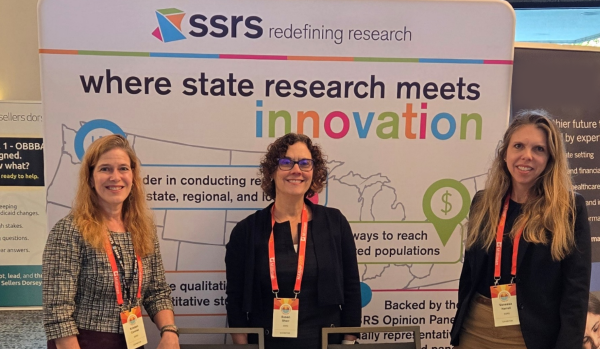
Robyn Rapoport, Susan Sherr, and Kristen Conrad attended the National Academy for State Health Policy (NASHP) conference, participating in discussions on a wide range of topics, including Medicaid eligibility, health care costs, aging, substance use response efforts, rural health, and home- and community-based services.
Across sessions, several common themes emerged. Whether discussing substance use, caregiving, workforce shortages, or Medicaid policy, speakers frequently returned to a shared set of challenges and opportunities facing states today.
Five Themes Repeated Across NASHP, Regardless of Topic Area
1. States Are Planning for Scarcity
Nearly every plenary session highlighted the reality of constrained resources. State leaders discussed the fiscal implications of federal policy changes, rising Medicaid utilization, increasing behavioral health needs, growing long-term services and supports expenditures, and escalating health care costs. Alongside the loss of resources, many speakers emphasized the growing administrative and operational demands required to maintain coverage, implement new requirements, and sustain essential services.
One speaker remarked that the current moment feels in some ways more difficult than the COVID-19 pandemic. During COVID, states were managing a crisis while resources flowed into systems. Today, many are navigating significant needs and uncertainty while trying to do more with less.
Rather than focusing solely on expansion, many conversations centered on sustainability: How can states preserve access, support vulnerable populations, and maintain progress in a period of fiscal constraint?
2. Data Have Become a Strategic Necessity
The need for better data emerged in discussions about rural health, aging, home- and community-based services (HCBS), value-based care, substance use, and Medicaid administration. Reliable, actionable data have become essential for decision-making, not just a tool for reporting outcomes.
States want to understand which investments work, where variation exists, how services affect outcomes over time, and what tradeoffs policy decisions may create. Several speakers highlighted the importance of using data to evaluate innovation and measure impact across programs and populations. Whether through Medicaid Section 1115 waivers or other pilot programs, states are increasingly testing new approaches to improving health and controlling costs. But innovation only creates value when policymakers can determine what worked, for whom, and under what circumstances.
Several speakers also discussed the need for better information about the direct care workforce, including paid and family caregivers, to inform planning, workforce development, and long-term care policy.
While data are widely viewed as essential, discussions also revealed ongoing challenges with data quality, integration and accessibility. Parinda Khatri (River Valley Health) described fragmented and inaccurate data systems. Aging and HCBS leaders noted gaps in the information needed to understand individuals’ experiences over time. Others stressed the importance of making data more actionable for providers, policymakers, and communities.
3. Trust Remains the Foundation for Change
While policies and funding matter, many speakers highlighted the role of trusted partnerships in driving change.
Chinazo Cunningham, Commissioner, NY Office of Addiction Services and Support described the importance of working with local communities, people with lived experience, faith leaders, providers, corrections systems, and other state agencies to expand access to addiction treatment.
Leaders across multiple sessions emphasized that sustainable change requires listening to communities, sharing decision-making, encouraging transparency, and designing solutions alongside those most affected. Heidi Hedberg, Commissioner, Alaska Department of Health spoke specifically about the importance of community-led transformation in Alaska in addressing health challenges and ensuring solutions can be sustainable.
Kim Boswell, Commissioner, Alabama Dept. of Health, quoted Stephen Covey’s observation that “change happens at the speed of trust.” That sentiment echoed across discussions involving Medicaid, substance use treatment, rural transformation, and aging policy.
4. Technology Can Help, but People Remain Central
Artificial intelligence and technology were recurring themes in discussions ranging from Medicaid administration to caregiving and rural health.
Louisiana Health Secretary Bruce Greenstein noted that states should be exploring how emerging technologies, including agentic AI, can reduce administrative burden and improve efficiency. Aging and caregiving leaders pointed to technology’s potential to reduce isolation and help individuals remain safely at home, while rural health leaders described the critical role of telehealth and remote monitoring in expanding access to care. Assistive technologies already exist, and heightened awareness of these tools can also enable people to remain at home vs. having to move to a more expensive nursing situation.
At the same time, there was notable caution. Several leaders emphasized that technology should strengthen, rather than replace, human relationships. Concerns were raised about the use of AI in coverage determinations and care decisions. Compelling examples involved technology serving as an enabler: helping clinicians spend more time with patients, supporting caregivers, extending services into rural communities, or simplifying complex administrative processes.
Across conversations, there was broad agreement that AI and technology will play an increasingly important role. The larger question is how to deploy it in ways that improve the experiences and outcomes for the people it is intended to serve.
5. Health Extends Far Beyond Health Care
One message cut across nearly every topic area: improving health requires looking beyond the health care system itself.
Speakers discussed the importance of housing, transportation, caregiving, broadband access, workforce participation and job training, food security, social supports, community connections, and access to services close to home. Support for these areas has also shown to reduce the need for other health services down the road.
Rani Snyder, President of the John A. Hartford Foundation, noted that approximately 63 million Americans now serve as caregivers, spending an average of 27 hours per week caring for a family member or loved one.
Medicaid leaders focused on helping people remain healthy rather than simply treating illness. Valerie Arkoosh, Pennsylvania Secretary of Human Services, described PA’s “north star” as improving health, not simply health care.
That distinction may be one of the most important takeaways from the conference. While the policy discussions differed considerably across sessions, many speakers shared a broader vision of what drives health and well-being. Medical care remains a critical component, but it is only one part of a much larger system that shapes people’s lives.
SSRS State Research
At SSRS, we understand the complex challenges facing states today. Our State Research expertise spans statewide health surveys, policy research, public opinion studies, program evaluations, and community-based research. By combining methodological rigor with a deep commitment to understanding people’s lived experiences, we help clients generate the evidence needed to make informed decisions and drive meaningful change.
Want more info on SSRS State Research?
We'd love to work together! Email us and we'll get right back to you.