
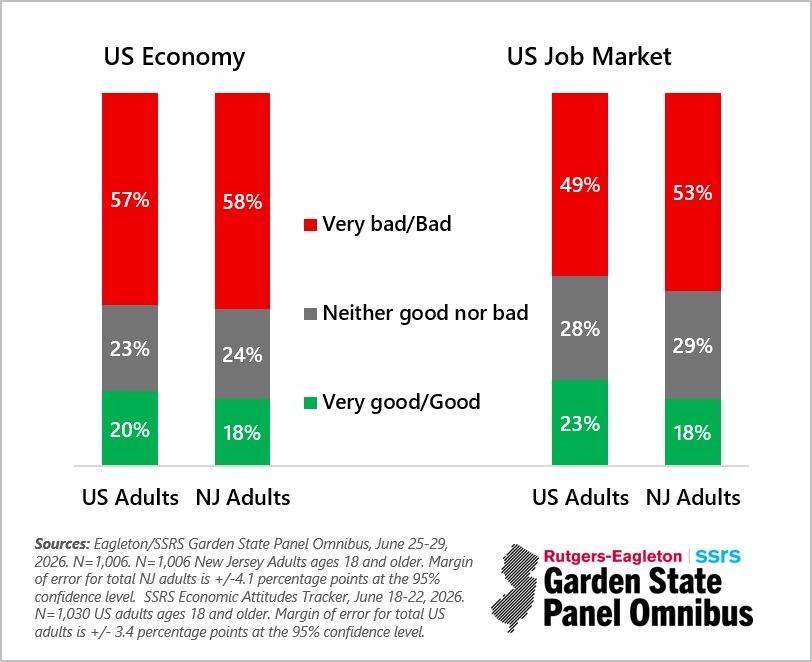
New Jersey residents view the national economy and job market much like Americans overall, with a majority giving both negative ratings.
Fifty-eight percent of New Jersey residents rate the U.S. economy as bad or very bad, nearly identical to the national figure (57%). Similarly, 53% of New Jersey residents rate the U.S. job market negatively, compared with 49% nationally.
Despite concerns about the broader economy, many New Jersey residents are positive about their own circumstances.
While only 18% rate the US economy good or very good, nearly half (48%) rate their own financial situation as good or very good. Similarly, 52% of New Jerseyans say their own job situation is good or very good, despite just 18% saying the same about US job market. New Jersey residents are more likely than US adults generally to give positive ratings to their own financial situation (48% v. 40%) and employment (52% v. 46%).
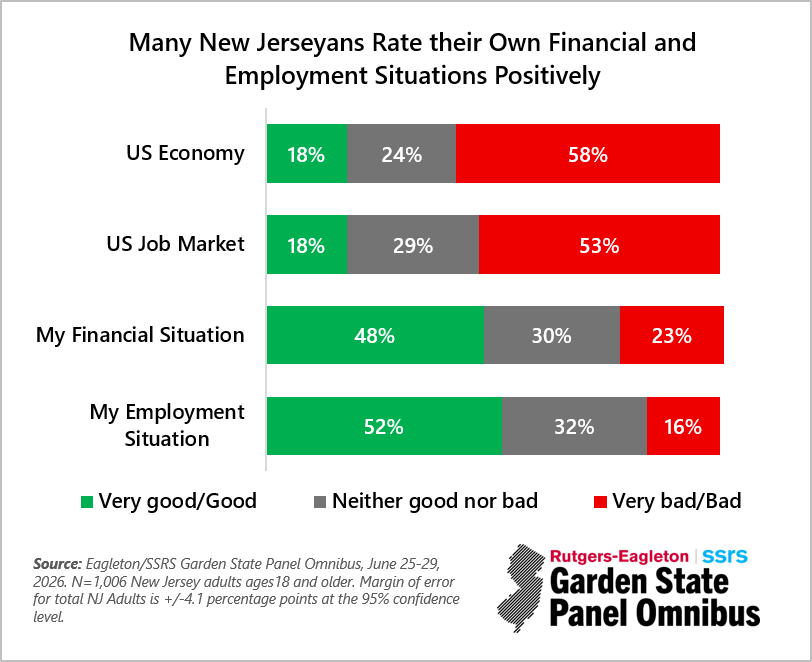
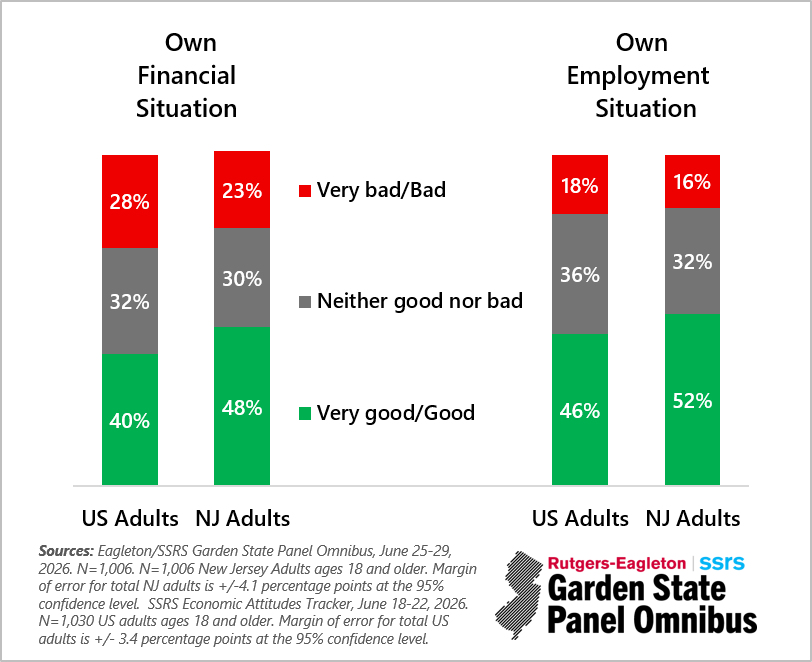
While New Jerseyans align with the rest of the country on their views of the US economy and job market, they are more likely to rate their personal circumstances positively.
New Jersey residents are more likely than US adults on the whole to give positive ratings to their personal financial situation (48% v. 40%) and their own employment situation (52% v. 46%).
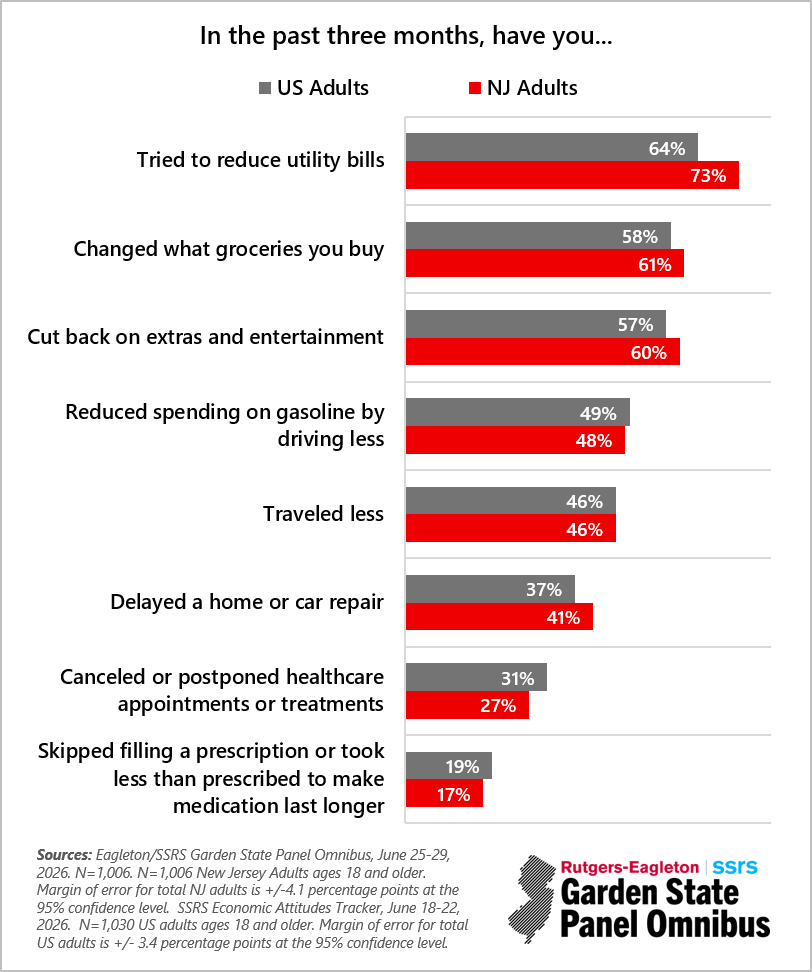
Still, economic pressures are shaping household spending and New Jersey residents are finding ways to cut back on expenses.
About three in four New Jerseyans (73%) report that in the three months prior to the survey they tried to reduce their utility bills (73%), significantly higher than the 64% of Americans overall who report the same. A majority of New Jerseyans also changed the groceries they buy to stay within budget and cut back on extras and entertainment to reduce their household spending. In contrast, New Jersey residents are slightly less likely than Americans overall (27% v. 31%) to report recently canceling or postponing healthcare appointments or treatments.
Economic sentiment and experiences vary sharply across different segments of the New Jersey population.
The state’s youngest adults, African American residents, and lower-income households are most pessimistic about the US economy and their own financial and employment situations. They report cutting spending on healthcare, groceries, and entertainment at higher rates than others in the state.
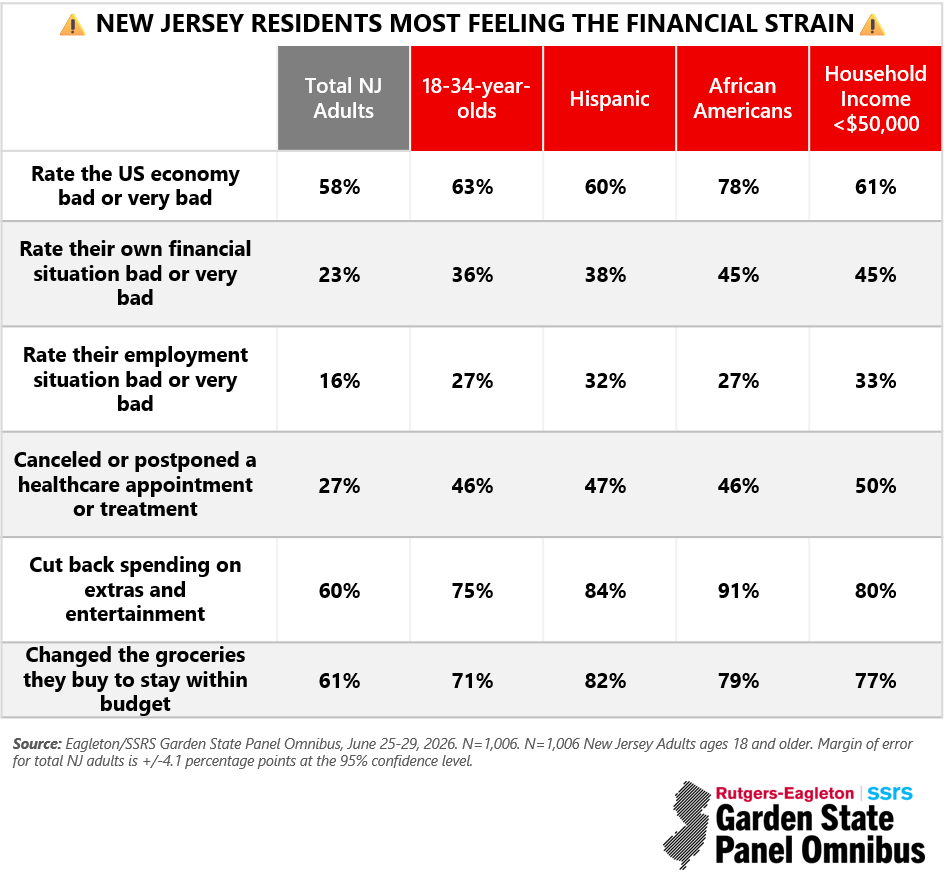
Among NJ adults ages 18 to 34, economic strain is far more common than among their older counterparts.
More than a third (36%) rate their own financial situation as bad or very bad, compared with 22% of those 50 to 64 and just 10% of those 65 and older. On employment, 27% of young adults rate their own situation negatively, versus 17% of those 35 to 49 and 9% of those 65 and older. Their spending cutbacks follow the same pattern: 75% cut back on extras and entertainment, 71% changed the groceries they buy, and 46% canceled or postponed a healthcare appointment or treatment, all well above the statewide figure. Young adults are also more downbeat on the national economy, with 63% rating it bad or very bad, though the most pessimistic age group is those 35 to 49, at 68%.
Black and Hispanic residents report deeper strain than other racial or ethnic groups.
Black (45%) and Hispanic (38%) are much more likely than white residents (16%) to rate their own financial situation most negatively. A similar pattern holds for personal employment situation, with 27% of Black New Jerseyans and 32% of Hispanic New Jerseyans rating it poorly compared with 10% of white New Jersey residents. More Black and Hispanic residents report cutting back on extras and entertainment (91% and 84% respectively compared with 47% of white residents), changing the groceries they buy to stay in budget (79% and 82% v. 55%), and canceling or postponing a healthcare appointment or treatment (44% and 47% v. 20%).
Economic strain follows a steady income gradient with 45% of residents in households earning less than $50,000 rating their own financial situation as bad or very bad.
The same is true of just 12% of those earning $100,000 to $149,999 and 6% of those earning $150,000 or more. One in three (33%) NJ residents in the lowest income households rate their employment situation negatively, versus 8% of the highest earners. The spending divide is just as sharp: 80% of lower-income residents cut back on extras and entertainment, 77% changed the groceries they buy, and half (50%) canceled or postponed a healthcare appointment or treatment, compared with 43%, 48%, and 16%, respectively, among residents earning $150,000 or more.
About the Study
This study was conducted on the Rutgers-Eagleton/SSRS Garden State Panel Omnibus. The Garden State Panel Omnibus is a quarterly, New Jersey statewide, probability-based survey. Data collection was conducted from June 25 – June 29, 2026, among a sample of 1,006 respondents. The survey was conducted via web and administered in English (n=992) and Spanish (n=14). The margin of error for total respondents is +/-4.1 percentage points at the 95% confidence level. All Garden State Panel Omnibus data are weighted to represent the target population of New Jersey adults ages 18 or older.
The Garden State Panel Omnibus is conducted on the Rutgers-Eagleton/SSRS Garden State Panel. The Panel is a joint research venture between The Eagleton Center for Public Interest Polling at the Eagleton Institute of Politics at Rutgers-New Brunswick (ECPIP) and SSRS. It is a probability-based panel of New Jersey adults age 18 or older. Members are recruited randomly based on statewide representative ABS (Address Based Sample) design. ABS sample is drawn from the Delivery Sequence File (DSF) maintained by the U.S. Postal Service. Population coverage of the DSF is in the 98%-99% range.
NOTE ABOUT RESULTS
Because percentages are rounded, they may not total 100%. An asterisk (*) indicates less than 0.5%.
View the Garden State Panel Omnibus Topline >>
View the SSRS Economic Attitudes Survey Topline >>
The Economic Attitudes Tracker is conducted by SSRS on its Opinion Panel Omnibus platform. The SSRS Opinion Panel Omnibus is a national, twice-per-month, probability-based survey. All SSRS Opinion Panel Omnibus data are weighted to represent the target population of U.S. adults ages 18 or older. The SSRS Opinion Panel Omnibus is conducted on the SSRS Opinion Panel. SSRS Opinion Panel members are recruited randomly based primarily on nationally representative ABS (Address Based Sample) design (including Hawaii and Alaska). ABS respondents are randomly sampled by Marketing Systems Group (MSG) through the U.S. Postal Service’s Computerized Delivery Sequence File (CDS), a regularly updated listing of all known addresses in the U.S. For the SSRS Opinion Panel, known business addresses are excluded from the sample frame. Additional panelists are recruited via random digit dial (RDD) telephone sample of cell phone numbers connected to a prepaid cell phone. This sample is selected by MSG from the cell phone RDD frame using a flag that identifies prepaid numbers. Prepaid cell numbers are associated with cell phones that are “pay as you go” and do not require a contract. The SSRS Opinion Panel is a multi-mode panel (web and phone). Most panelists take self-administered web surveys; however, the option to take surveys conducted by a live telephone interviewer is available to those who do not use the internet as well as those who use the internet but are reluctant to take surveys online.